1
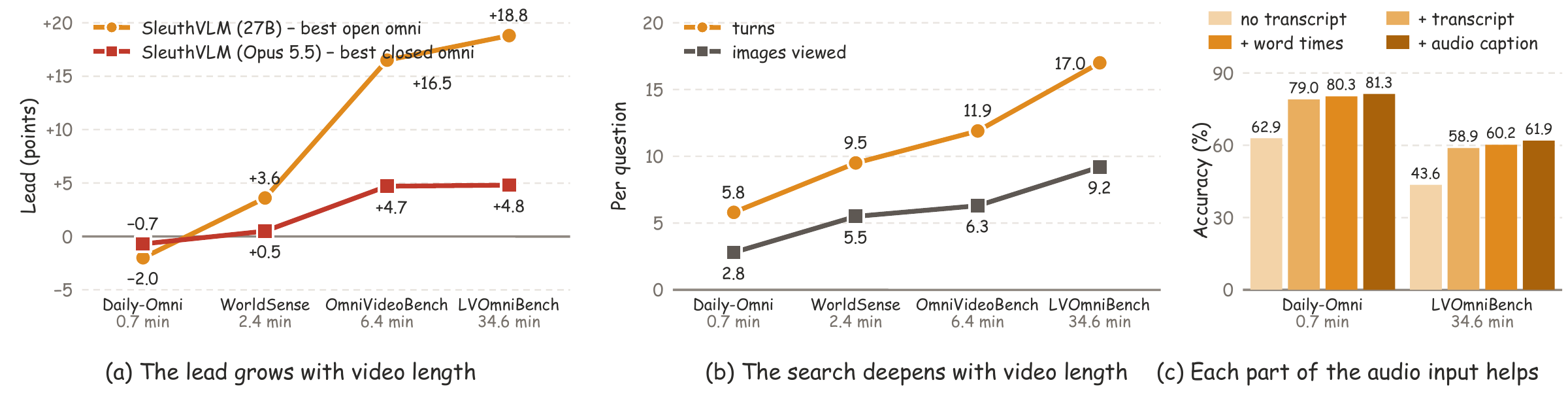
Searching outperforms passive observation.
Agentic inference improves accuracy by up to 10.3 points, and our simple harness outperforms agents equipped with specialized tools.
1University of Bristol 2Ant Group 3Tsinghua University
†Corresponding author



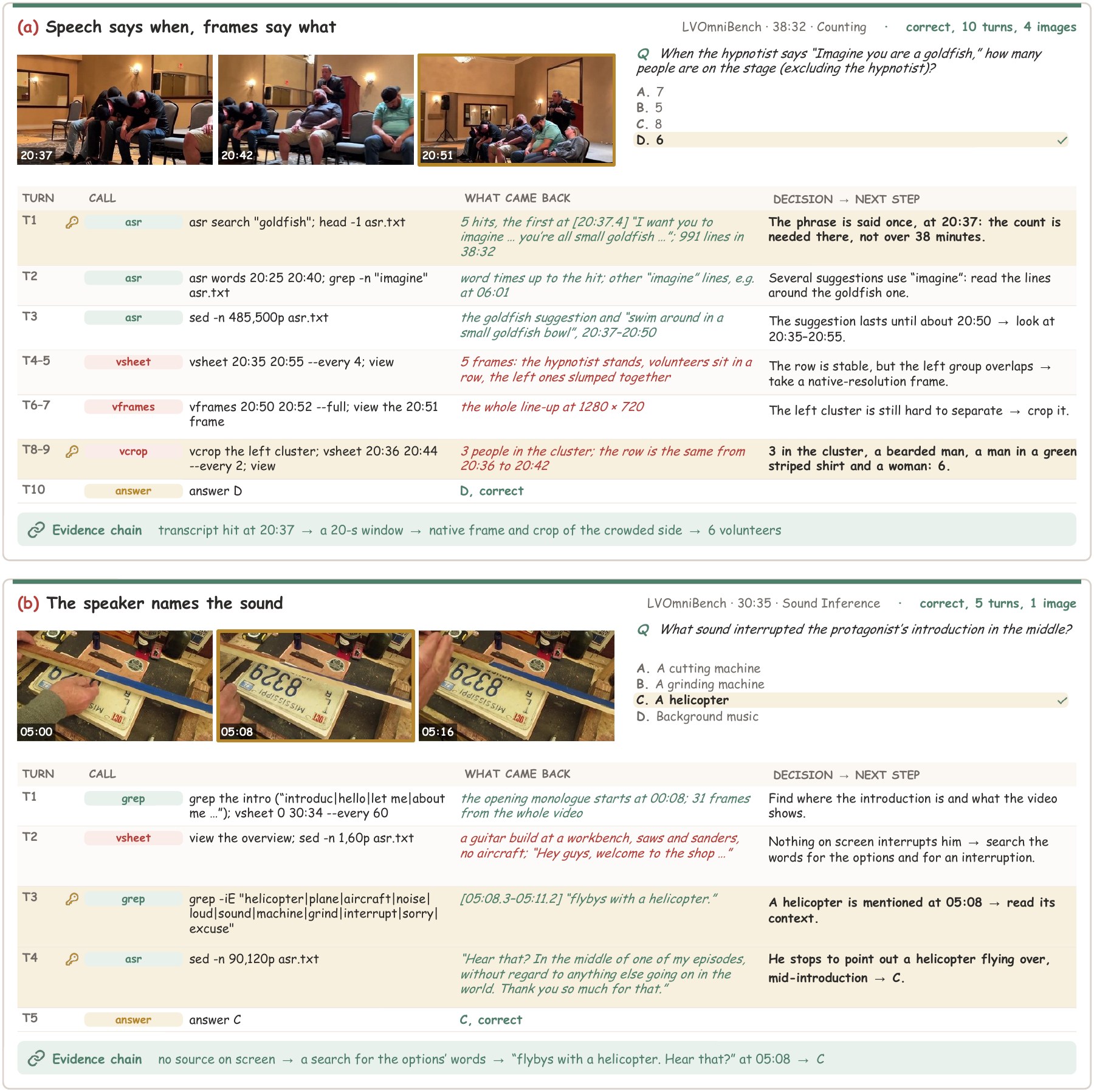
SleuthVLM answering two LVOmniBench questions on 36- and 59-minute videos, replayed from its logged trajectories. Commands, outputs and reasoning are quoted verbatim, and every image the model looked at is re-created by re-running its own commands; footage tagged “source video” is shown for the viewer, and on-frame labels mark what the model’s reasoning refers to.
Omni models answer questions about videos by jointly processing sampled frames and audio in one turn, with progress driven largely by scaling model size and omni training data. We ask whether a model needs to hear the audio directly at all, and present SleuthVLM, an agent harness built on a VLM that never hears the audio directly: speech is transcribed into text, and the VLM sleuths the video on its own without any predefined workflow. On four omni benchmarks with videos up to 90 minutes, SleuthVLM achieves the best average accuracy, 75.0%, 2.6 points above Gemini 3.8 Flash, and it also tops the Video-MME-v2 leaderboard with 77.8%; with an open-source 27B VLM, it beats all open-source omni models. We draw three findings: searching outperforms passive observation; agentic ability matters more than direct audio access, as omni training costs part of a VLM’s agentic ability; and small agentic models are highly competitive. So we provide a simple but effective starting point for omni video understanding.
Agentic inference improves accuracy by up to 10.3 points, and our simple harness outperforms agents equipped with specialized tools.
Even with access to audio, omni models in our harness perform below SleuthVLM with Opus 5.5, which relies on transcripts; omni models also need strong agentic capabilities.
An open 27B VLM running on a single GPU matches the performance of closed-source omni models.
Taken together, SleuthVLM provides a simple yet effective starting point for agentic omni video understanding.
SleuthVLM answers audio-visual questions with a vision-language model that never hears the audio directly. The audio is transcribed once per video with word-level timestamps, and the VLM uses a small set of tools to search the video and the transcript. The harness specifies only the accessible resources, a brief operating guide and a budget; the VLM decides where to look, how closely to inspect and when to stop, using the transcript as an index into long videos.
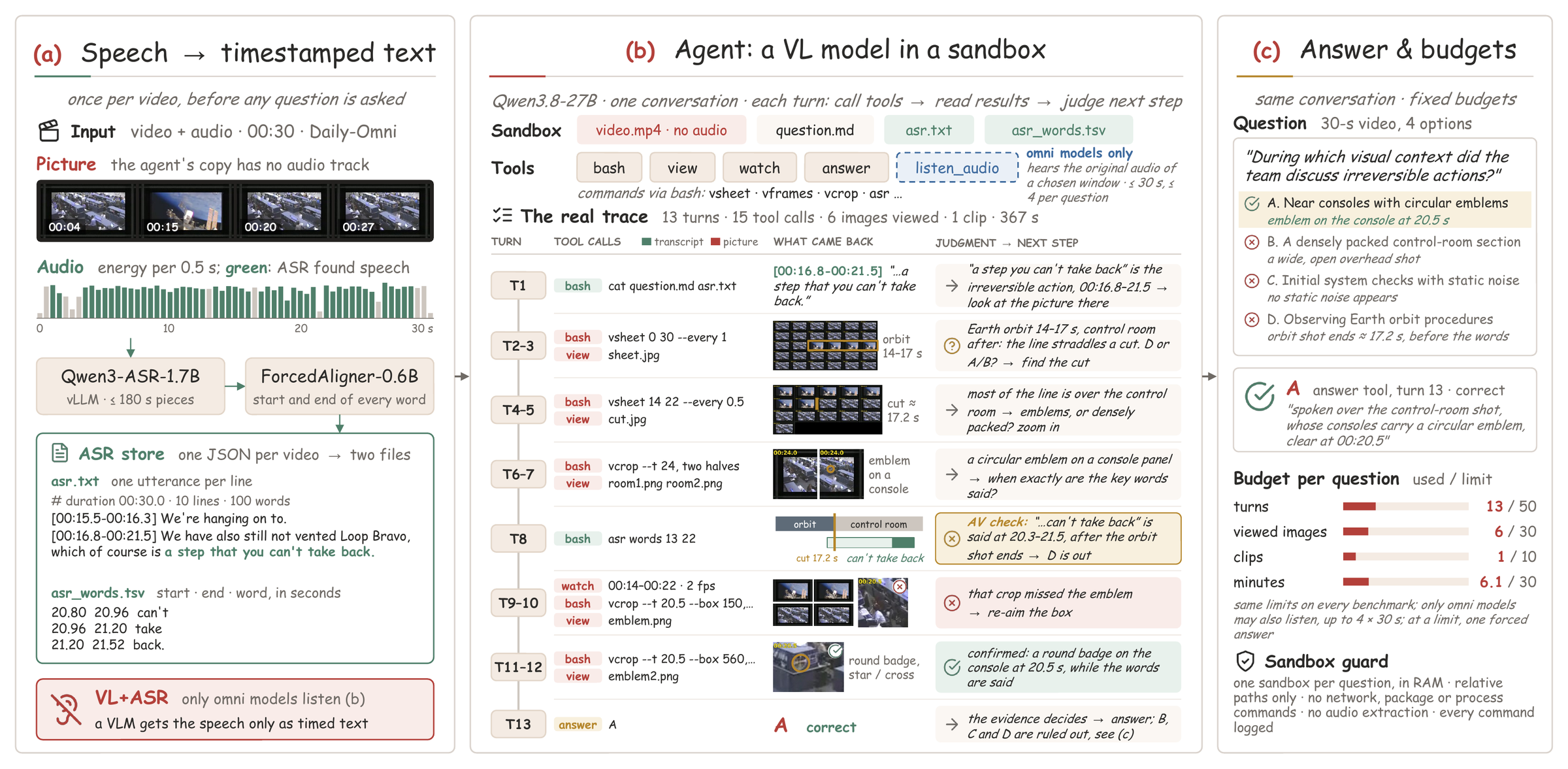
Qwen3-ASR-1.7B transcribes the speech and Qwen3-ForcedAligner-0.6B gives every word its start and end time. Stretches without words are kept as gaps, which point to music and other sounds.
In a sandbox with the muted video and the transcript, the VLM searches the words, looks at contact sheets, zooms into frames and crops, and watches short clips.
asrvsheetvframesvcropwatchview
The model stops as soon as the evidence settles the question, within a fixed budget of turns, images, clips and time. Any VLM can serve as the reasoning model without changes.
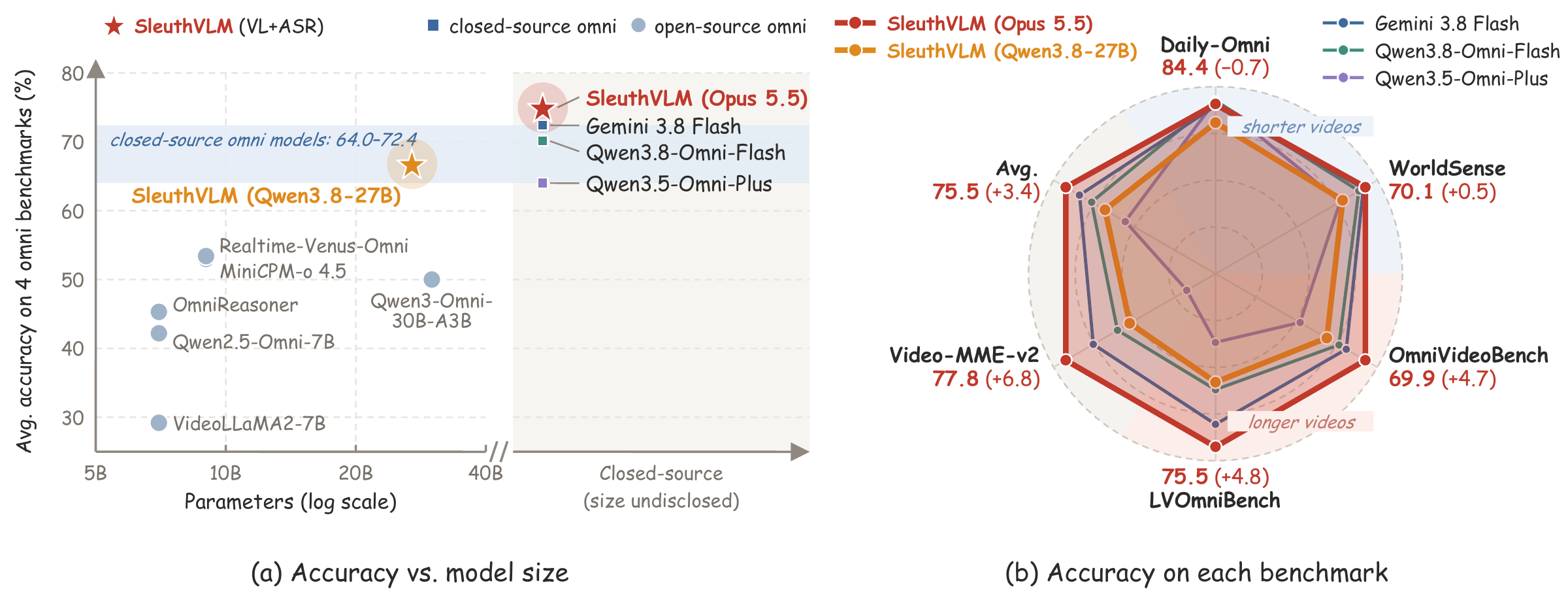
Without hearing the audio directly, SleuthVLM (Opus 5.5) achieves the best average accuracy on four omni benchmarks, ahead of every closed-source omni model, and its lead grows with the length of the video. With an open 27B model, SleuthVLM leads the best open-source omni model by 13.4 points on average and by 18.8 on LVOmniBench.
| Model | Input | Daily-Omni | WorldSense | OmniVideoBench | LVOmniBench | Avg. |
|---|---|---|---|---|---|---|
| Closed-source omni models | ||||||
| Gemini 3.8 Flash | A+V | 84.0 | 69.6 | 65.2 | 70.7 | 72.4 |
| Qwen3.8-Omni-Flash | A+V | 85.1 | 68.5 | 63.4 | 63.3 | 70.1 |
| Qwen3.5-Omni-Plus | A+V | 85.1 | 63.9 | 53.8 | 53.2 | 64.0 |
| Seed 2.0 Lite | A+V | 81.4 | 67.3 | 58.5 | – | – |
| Muse Spark 1.2 | A+V | 79.6 | 65.0 | 62.2 | – | – |
| Open-source omni models | ||||||
| Realtime-Venus-Omni | A+V | 81.3 | 54.0 | 39.2 | 38.9 | 53.4 |
| MiniCPM-o 4.5 | A+V | 80.2 | 55.7 | 41.1 | 34.8 | 53.0 |
| Qwen3-Omni-30B-A3B | A+V | 71.9 | 54.0 | 38.4 | 35.8 | 50.0 |
| video-SALMONN-R3 | A+V | 78.7 | – | 43.9 | 42.9 | – |
| LongCat-Flash-Omni | A+V | 82.4 | 60.9 | – | – | – |
| video-SALMONN 2+ (72B) | A+V | 79.4 | 56.5 | – | – | – |
| Nemotron 3 Nano Omni | A+V | 74.5 | 55.2 | – | – | – |
| Omni agents | ||||||
| OmniReasoner | A+V | 64.2 | 46.7 | 34.8 | 35.4 | 45.3 |
| OmniAgent (o3 + Gemini + Qwen) | A+V | 82.7 | 61.2 | 59.1 | – | – |
| OmniAgent (7B) | A+V | 64.8 | 47.2 | 37.1 | – | – |
| Qwen3.8-Omni-Flash (Qwen Code) | A+V | – | – | 67.8 | 73.6 | – |
| Gemini 3.8 Flash (Qwen Code) | A+V | – | – | 70.1 | 70.7 | – |
| VL + ASR agents | ||||||
| Qwen3-VL-30B-A3B + TFO | V+ASR | 68.9 | 51.9 | – | – | – |
| SleuthVLM (Qwen3.8-27B, medium) | V+ASR | 80.3 (−2.1) | 62.8 (+1.9) | 58.3 (+14.4) | 60.2 (+17.3) | 65.4 (+12.0) |
| SleuthVLM (Qwen3.8-27B) | V+ASR | 80.4 (−2.0) | 64.5 (+3.6) | 60.4 (+16.5) | 61.7 (+18.8) | 66.8 (+13.4) |
| SleuthVLM (Opus 5.5) | V+ASR | 84.4 (−0.7) | 70.1 (+0.5) | 69.9 (−0.2) | 75.5 (+1.9) | 75.0 (+2.6) |
SleuthVLM (Opus 5.5) also sets a new state of the art on Video-MME-v2: with 77.8% average accuracy and a non-linear score of 63.5, it is the best model on every metric of the leaderboard, 6.8 points above Gemini 3.8 Flash in accuracy. Over the four omni benchmarks and Video-MME-v2 together, it achieves the best average, 75.5%. With Qwen3.8-27B, SleuthVLM reaches 62.0% accuracy and a non-linear score of 44.4, ahead of Gemini-3-Flash, GPT-5 and every open-source model on the leaderboard.
| Model | DO | WS | OVB | LV | VM2 | Avg. |
|---|---|---|---|---|---|---|
| SleuthVLM (Opus 5.5) | 84.4 | 70.1 | 69.9 | 75.5 | 77.8 | 75.5 |
| Gemini 3.8 Flash | 84.0 | 69.6 | 65.2 | 70.7 | 71.0 | 72.1 |
| Qwen3.8-Omni-Flash | 85.1 | 68.5 | 63.4 | 63.3 | 65.0 | 69.1 |
| SleuthVLM (Qwen3.8-27B) | 80.4 | 64.5 | 60.4 | 61.7 | 62.0 | 65.8 |
| Qwen3.5-Omni-Plus | 85.1 | 63.9 | 53.8 | 53.2 | 47.9 | 60.8 |
| Gemini 3.8 Flash (QC) | – | – | 70.1 | 70.7 | 72.7 | – |
| Qwen3.8-Omni-Flash (QC) | – | – | 67.8 | 73.6 | 71.3 | – |
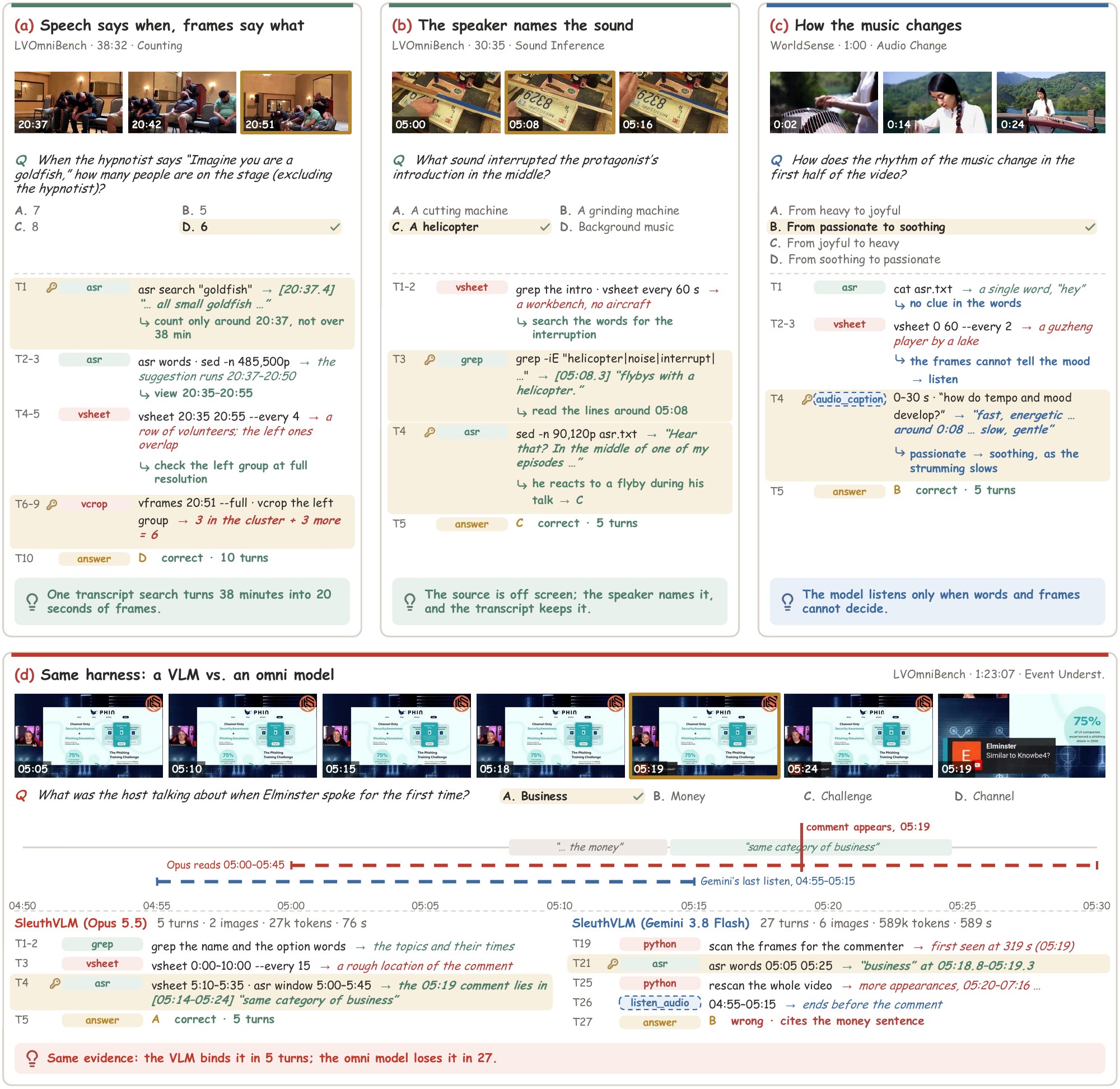
In (a), one search of the transcript lands at 20:37 of a 38-minute show, and the model counts six people after viewing only the 20 seconds around it. In (b), the helicopter never appears on screen, but the transcript holds the speaker naming it: “flybys with a helicopter. Hear that?”
In (c), neither the transcript, a single word, nor the frames tell how the music changes. One call to audio_caption on the first 30 s returns a fast opening that turns slow and gentle near 0:08, and the model checks it against the strumming in the frames.
In (d), Opus 5.5 binds a viewer’s first comment at 05:19 of an 83-minute stream to the sentence spoken at that moment in five turns. Gemini 3.8 Flash finds the same evidence, loses it, and answers wrongly after 27 turns and 21 times the tokens.
@misc{wu2026sleuthvlmreallyneedaudioinvideo,
      title={SleuthVLM: Do We Really Need Audio-in-Video for Omni Video Understanding?},
      author={Peiran Wu and Fangfei Gou and Zhaoxi Mu and Changhao Zhang and Jian Liu and Weiqiang Wang and Yuntao Wang and Yuanchun Shi and Junxiao Shen},
      year={2026},
      eprint={2611.06083},
      archivePrefix={arXiv},
      primaryClass={cs.CV},
      url={https://arxiv.org/abs/2611.06083},
}